
10 Moments That Prove The Wisest Kindness Often Comes With Age

There’s a particular kind of kindness that seems to belong to older people—the kind that doesn’t announce itself, doesn’t expect thanks, and often hides behind a gruff exterior or a habit you don’t understand until much later.
Maybe it comes from having lived long enough to know how short everything really is. Maybe it comes from loneliness, from knowing exactly what it feels like to be overlooked.
Whatever the source, the people in these stories share something: they noticed.
They paid attention when no one asked them to, and they acted in small, quiet ways that the people on the receiving end never forgot. A janitor with cookies in his pockets. A widower waiting up past midnight. A woman at her window who, it turns out, was keeping watch over an entire street.
We asked people to share a memory of an older person whose quiet kindness stuck with them. Their answers, gathered below (and edited for readability), are a reminder that wisdom and warmth often arrive together—and that the people we’re quickest to misjudge are sometimes the ones holding the whole neighborhood together.
1. The Neighbor Whose Noise Complaints Were a Cover Story

Okay so I have to preface this by admitting I was kind of a brat about my downstairs neighbor for like two years. Mr. Petrov. Old guy, super intense eyebrows, would knock on my door at the most random times to “discuss” the noise—even when I swear I wasn’t making any. I genuinely thought he hated me.
Then I got the flu. Bad. The kind where you don’t leave your apartment for five days and you start to question whether anyone would notice if you just dissolved into your mattress. And every single one of those mornings, there was a thermos of this beet soup outside my door. No note. I only figured out it was him because I caught him shuffling away one time, pretending he was just “checking the hallway light.”
Turns out the noise complaints were his excuse to check that I was alive. He lived alone. I was, I think, the closest thing he had to company. I bring HIM soup now.
2. The Woman Who Ran a Rescue Operation From Her Porch
I drove a delivery route for eleven years before my knees gave out. Same streets, same houses, you get to know a place. There was one woman on Aldous Street—Miss Ettie, everybody called her—must have been ninety if she was a day. Sat on her porch from sunup, sweet tea beside her, watching.
Folks thought she was just an old woman with nothing better to do. Wrong. That woman ran a quiet operation. She knew which kids walked home alone and made sure they passed where she could see them. She knew when the Hendersons’ boy stopped going to school and called his mama about it before it got bad. Knew when a package sat too long on a porch and somebody might be sick inside.
One August she flagged me down, pointed at a house, said “You knock on that door, baby.” Old man inside had been on the floor since the night before. She saved his life from a rocking chair. Never once took credit. Just sipped her tea.
3. The Cold Grandfather and the Secret Ledger
My grandfather was not a warm man. I want to be honest about that, because the internet loves a cuddly grandpa story and this isn’t quite that. He was a retired machinist, didn’t say “I love you,” communicated almost entirely through criticism of how you were holding a tool wrong.
After he died we cleaned out his workshop. In a drawer, organized with this almost painful precision, were decades of repaired things. Toys. A kid’s bicycle. A music box. And a ledger—an actual ledger—listing every neighborhood child he’d quietly fixed something for, going back forty years. No names of parents. Just the kids. “Tommy, red wagon, axle.” “Little girl two doors down, doll arm.”
He’d been the guy who fixed what kids broke so they wouldn’t get in trouble at home. Forty years. Never mentioned it once. The man who couldn’t say a kind word had been doing kind things in a locked workshop the whole time.
4. The Late-Night Regular Who Circled My Way Out

Working night shift at a 24-hour diner you meet every kind of person. But there was this regular, came in maybe 2am most nights, real old guy, ordered coffee and toast and that’s it. Tipped on a $4 check like it was a steakhouse.
I finally asked him once why he always came in so late. He said his wife passed three years back and the apartment got “too loud with the quiet” around then. So he’d come sit where there were people. didn’t need to talk to us. just needed to not be alone in it.
Here’s the part that gets me though.
He clocked that I was always tired, always stressed about money. Started leaving the local paper folded to the jobs section with little circles around stuff he thought I’d be good for. Better paying stuff.
I got my current job from one of those circles. Went to tell him and the other waitress said he’d passed that week. Never got to say thanks.
5. The Silence I Mistook for Disapproval
This is about my mother-in-law, and I’ll admit our relationship started rocky.
I was sure she didn’t approve of me. She had this way of going silent and just observing that I read as judgment for the first couple of years of my marriage.
What I eventually understood is that she wasn’t judging. She was studying. She remembered everything—that I take my coffee a strange way, that I get migraines from a certain wine, that I’d offhandedly mentioned loving a candy from my childhood that they stopped making decades ago.
That last one. She tracked down a small company overseas that still made it. A box arrived on my birthday with no fanfare, just a sticky note in her shaky handwriting: “You mentioned these.” I sat on the kitchen floor and cried, frankly.
All that silence I’d taken as coldness was her paying closer attention to me than almost anyone ever had.
6. The Crossing Guard Who Knew Every Name
Retired teacher here. Forty-one years in elementary classrooms, and the kindest person I ever worked beside was our crossing guard, Walter. Pushing eighty. Stood at that corner in every weather you can imagine.
Now, anyone can wave kids across a street. Walter did something else. He memorized them. Every child’s name, hundreds of them, and one thing about each—a soccer game coming up, a sick grandma, a lost tooth.
“How’d the spelling test go, Marcus?” “Tell your mom I hope she feels better, sweetheart.” For a lot of those kids, his was the first kind voice of the day, and for some of them, I came to realize, the only one.
When he finally retired, the families organized a surprise. Hundreds of people lined that street. Grown adults who’d crossed at his corner as five-year-olds drove in from other states.
He just kept saying he didn’t understand the fuss. He’d only been saying good morning. But good morning, said like you mean it, every day, for thirty years—that’s a kind of love most of us never manage.
7. The Barbershop Regular Who Quietly Paid It Forward

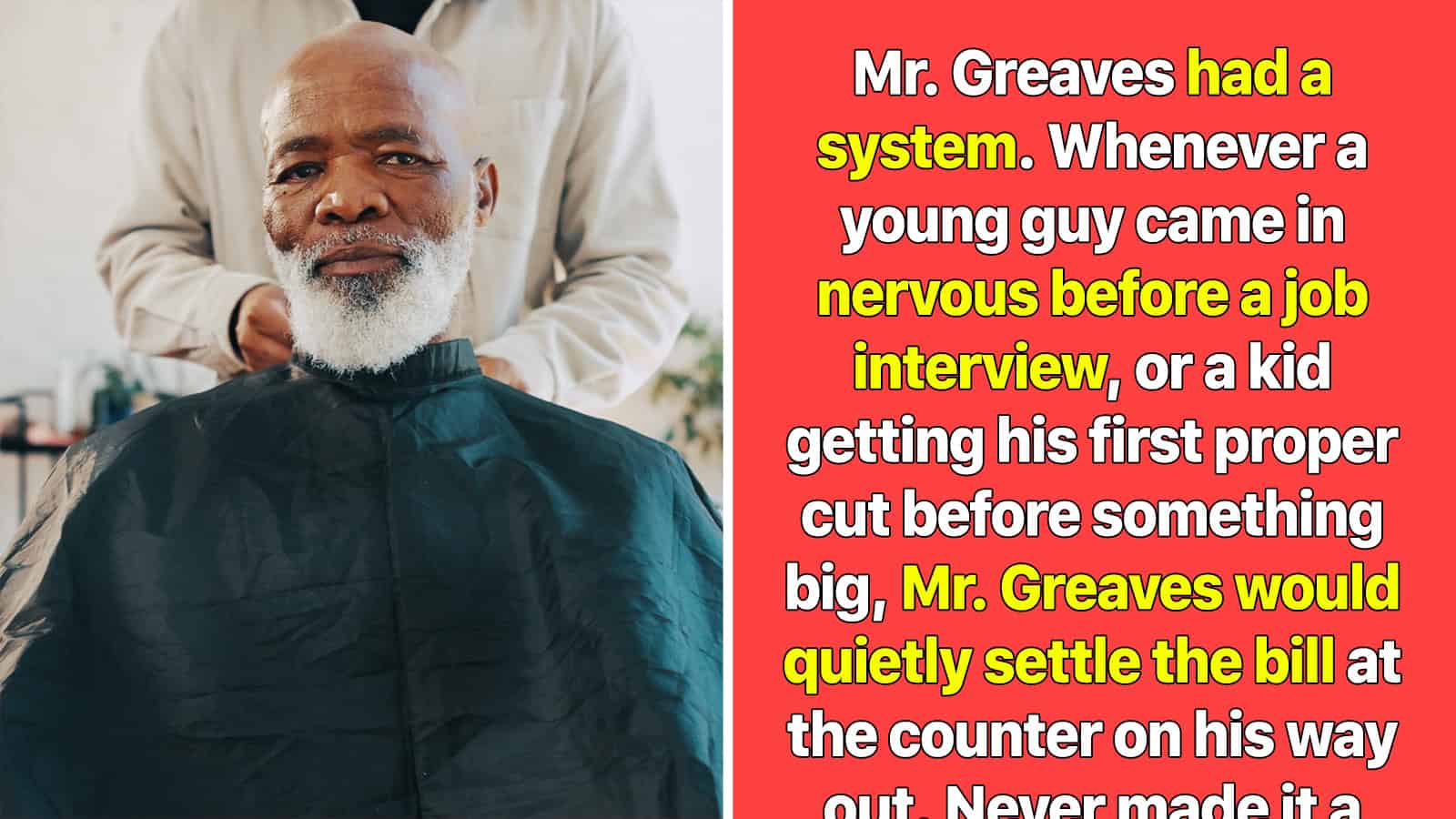
My dad owns a barbershop and there was an old fella, Mr. Greaves, used to come in every Saturday. Didn’t even need a haircut half the time, in my honest opinion. Bald as an egg up top. He came for the room, you know? The talk.
What I didn’t notice as a kid, but my dad pointed out to me later, was that Mr. Greaves had a system. Whenever a young guy came in nervous before a job interview, or a kid getting his first proper cut before something big, Mr. Greaves would quietly settle the bill at the counter on his way out. Never made it a thing. The barber was just told, “tell him it’s handled, don’t say who.”
He’d been laid off himself as a young man, my dad said, gone to an interview with holes in his shoes. Somebody helped him once. He spent his retirement quietly paying it back to strangers, one fresh haircut at a time.
8. The Landlady Who Didn’t Need Words
I was nineteen and very far from home, studying abroad, and extremely not okay about it. Homesick in a way that felt physical.
I’d rented a room from an elderly landlady, Signora Bruno, who spoke about four words of English to my four words of Italian.
We couldn’t really talk. But she could see.
The first week she found me crying in the stairwell and she didn’t ask questions—couldn’t have understood the answers anyway. She just sat down on the step beside me. Didn’t say anything. Just sat, this tiny woman, her shoulder against mine, until I stopped.
After that there was always a little extra at dinner. A plate left covered on the stove if I came in late. Once, an orange peeled and sectioned, left on the table by my books like my own grandmother used to do. She never said a word about any of it. She didn’t need language. She’d been lonely too, I think, and she recognized it in me, and she answered it the only way she had.
9. The Watchmaker Who Spent His Last Days Thanking Us
Hospice volunteer. I’ll keep this one short because it still gets me.
We had a patient, late eighties, no family that ever visited. You’d expect a person in that situation to be bitter, turned inward, and nobody would blame him. He was the opposite. He spent what energy he had left worrying about us—the staff, the volunteers.
He’d been a watchmaker, and his hands didn’t work well anymore, but he asked a nurse to bring him paper and he wrote—slowly, over many days—a separate letter to every single person who cared for him. Mine told me I had “a steady way about me” and that I’d be a comfort to a lot of people in my life if I let myself. I keep it in my wallet.
A dying man, alone in the world, spent his last good days making sure the people around him felt appreciated. I think about that constantly.
10. The Garden Grump’s Best-Kept Secret

Alright, mine’s got a twist so stay with me. There was an old man at our community garden, Mr. Okonkwo, and the man was infamous. Territorial about his plot, complained about everyone’s technique, generally regarded as the garden grump. New members were basically warned about him.
So one season a young single mom joins, clearly struggling, clearly has no idea what she’s doing, and her plot is a disaster. We all kind of winced waiting for Mr. Okonkwo to tear into her. Instead? Her plot starts mysteriously thriving. Weeds gone overnight. Tomatoes staked. A little hand-drawn diagram appears showing her what to plant next to what.
We caught him eventually—dawn, on his knees in her plot, “fixing” it before she’d arrive so she’d never know she’d struggled. When confronted he got all defensive, grumbled that he “couldn’t stand to watch good soil go to waste.” Sure, Mr. Okonkwo. Sure. The grumpiest man in the garden had appointed himself secret guardian of the one person who needed it most. We never told her. He’d have hated that.
What ties all of these together is that none of these people thought they were doing anything remarkable. The soup, the circled job listings, the peeled orange, the letters written by a failing hand—to them, it was just what you do. That’s the quiet wisdom of a long life: you learn that the smallest gestures carry the most weight, and you stop needing anyone to notice. Have you ever misjudged an older person, only to discover they were caring for you all along? We’d love to hear about it.