
10 Quiet Moments That Prove Sibling Loneliness Is Never As Permanent As It Feels

There’s a particular kind of quiet that only a sibling can leave behind. Not the loud, dramatic absence of a falling-out — though those happen too — but the slow drift of two people who shared a childhood and then, somewhere along the way, stopped sharing anything at all.
I have a brother I love and a brother I have to work at, and for years I assumed that was just the deal. You get the sibling you get. What I didn’t understand is how much that second relationship was quietly costing me — and how common that ache actually is.
Sibling distance turns out to be one of the most widespread forms of family pain there is, and one of the least talked about. A 2025 YouGov poll found that 24% of American adults are currently estranged from a sibling — more than are estranged from a parent or a child. A peer-reviewed study in the Journal of Social and Personal Relationships put the lifetime figure even higher, at 28%.
And here’s the part that stopped me cold. Siblings are, for most of us, the longest-lasting relationships of our entire lives — longer than the one with our parents, our partners, or even our own kids. They knew us before we knew ourselves.
So I started collecting moments — mine and other people’s — where that distance cracked open, even briefly, and something came back through.
Here are 10 of them, lightly edited, with a little of the psychology that explains why they land the way they do.
1. The funeral she didn’t come to

I took care of our mother for three years while my sister sent a text every few weeks.
When Mom died, my sister didn’t come to the funeral. I buried her with two neighbors and a funeral director and I kept my face perfectly still the whole time because there was no one there to fall apart in front of.
Last night my sister called me sobbing. She said, “I was so angry at her that I forgot you were grieving too.” I’m still angry at her. I’m also still her sister.
We stayed on the phone for two hours. I think it was the start of something neither of us has a name for yet.
This is the thing people get wrong about estrangement: it’s rarely about one villain.
The death of a parent is one of the disruptive family events most strongly linked to sibling rifts in the research — but it’s also, sometimes, the thing that ends them.
Grief makes us narrow. It can take a while to remember that the person on the other side of the silence is grieving too.
2. He drove two hours to a game he didn’t care about
My brother and I hadn’t spoken in six years after our father’s estate turned ugly. Last spring my fourteen-year-old came home and said a man had come to watch his football game — described him, and it was my brother.
He’d driven two hours to watch a nephew he barely knew play a sport he doesn’t even like, then left without telling me. My son said, “He kept cheering. He seemed really proud of me.” I called my brother that night for the first time in six years. He picked up like no time had passed.
Psychologists draw a sharp line between forgiveness and reconciliation. You don’t have to feel the first to attempt the second.
Reconnection often starts not with a big apology but with a single gesture that says I’m still here — a gesture quiet enough that no one has to lose face to accept it.
3. Three missed calls in the middle of the night
My brother called three times one night and I saw it the next morning and texted back asking what he needed, like it was a work email. A week later I looked at the timestamps. 11pm. 11:40. 12:15. He’d called three times in the middle of the night and I’d answered the next day asking what he needed. I called him immediately. He said he was fine. I said I didn’t think that was true. He went quiet, then told me what was really going on.
I’ve called him every Sunday since. He always picks up. I think he was just waiting for me to start.
One reason these misses sting so much: research finds that even when adult siblings talk less often after leaving home, they tend to rate those conversations as more meaningful. A late-night call from a brother who never calls is almost never administrative. It’s the rarity that’s the message.
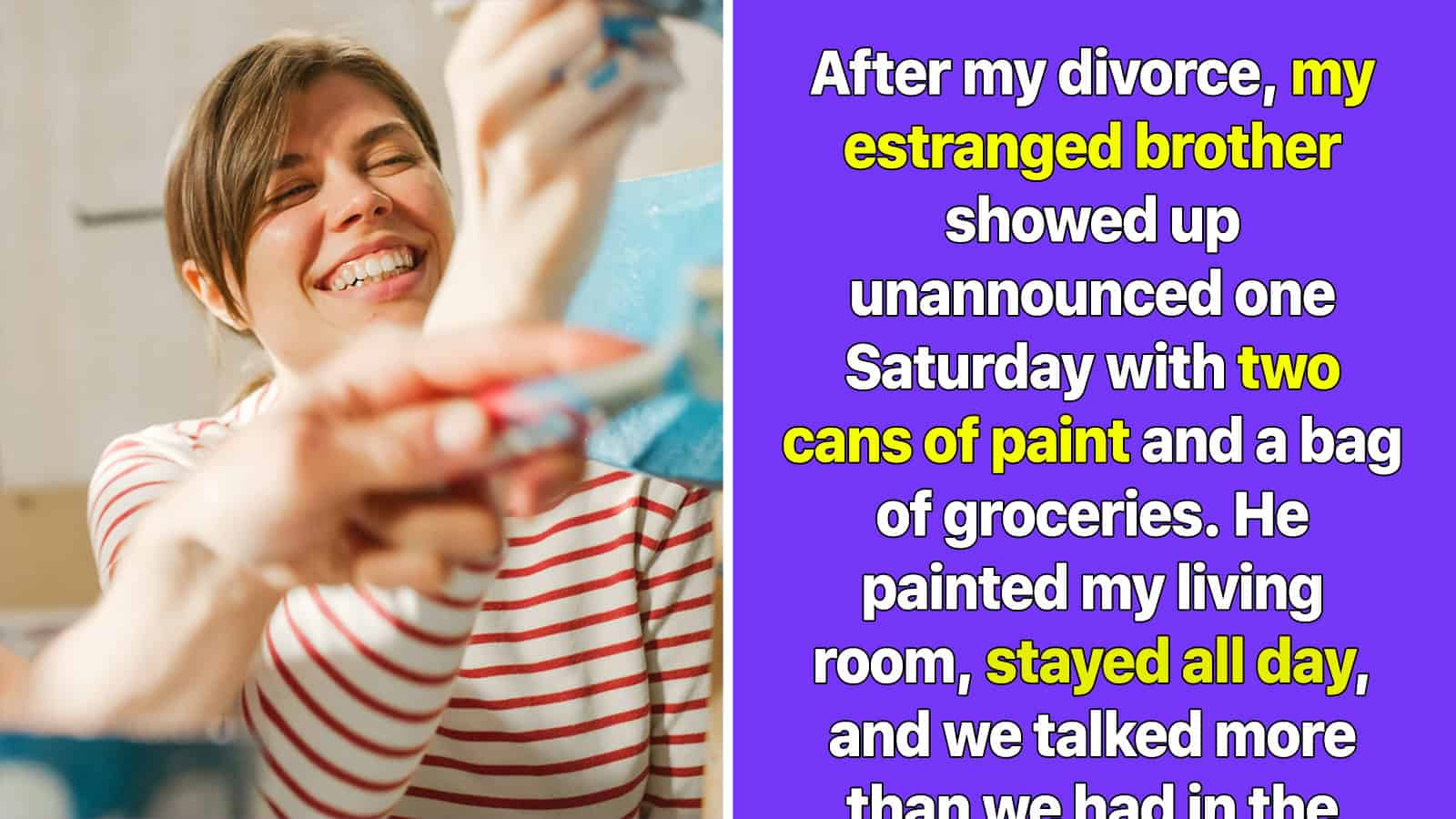
4. The paint cans on a Saturday morning

I bought my first house at 34 after a divorce that took almost everything, and I was doing it alone and pretending that was fine.
My brother — who I’d always had a complicated relationship with — showed up unannounced one Saturday with two cans of paint, a roller, and a bag of groceries. I said I hadn’t asked for help. He said, “I know.” He painted my living room and stayed all day.
We talked more that afternoon than in the previous five years combined. When he left he said, “You don’t have to do everything alone, you know.” I said, “I know.” I didn’t know. I’m learning.
There’s good evidence behind that instinct to show up. A longitudinal study of university students found that when people are chasing personal goals, sibling support is as valuable as support from parents or friends. A sibling who shows up doesn’t have to be your closest confidant to move the needle. They just have to show up.
5. “What do you need right now, today, in the next hour?”
I got a serious diagnosis at 38 and called my older sister before anyone else, which surprised me because we’d never been close. She listened to all of it without interrupting and then said, “Okay. What do you need right now, today, in the next hour?” Not what are you going to do, not have you told Mom. Just that. I said I didn’t know. She said, “Then I’m coming over and we’ll figure it out together.” She drove 90 minutes, brought food, helped me write questions for my doctor, and stayed the night.
I asked her later why that day, why so completely. She said, “Because you called me first. I wasn’t going to let that mean nothing.”
Being called first is its own kind of language. Siblings are often the only people who carry the full archive of where you came from — which is exactly why, in a crisis, they can sometimes understand you in ways no one else can, even after years of distance.
6. “I’m here.” That was all.
My twin and I had always been close, but three years ago we hit a wall over something I won’t go into, and we’d been careful with each other ever since — loving but guarded.
Last year something broke me open and she was the only person I wanted. I called her at 10pm and just said I needed her. She was at my door by midnight. She didn’t ask what happened and I didn’t explain. She just got into bed next to me like we were nine years old again, turned off the light, and said, “I’m here.” We lay in the dark and I cried for a long time. In the morning she made coffee and we talked properly for the first time in three years.
Not every repair needs a conversation. Sometimes presence does the work that words can’t, and the apology arrives wordlessly, in the form of someone simply refusing to leave you alone in the dark.
7. The 48 payments he never mentioned

Six years ago my brother borrowed a lot of money from me and never paid it back and never mentioned it again. When I brought it up once, he acted like I’d invented it. I let it go because the alternative was losing him.
What I didn’t know until last month is that he’d been transferring small amounts into my account every single month for four years, under a reference I’d never noticed. I went back through my statements. The total was almost exactly what he’d borrowed.
I called him and said, “I found the transfers.” Long pause. Then: “I always intended to pay you back. I just couldn’t figure out how to bring it up after so long.” We talked for two hours. It was the first honest conversation we’d had in years.
Shame is one of the great silencers in estranged families. People often don’t withdraw because they stopped caring — they withdraw because they can’t find a way back through the embarrassment.
Sometimes the repair is happening invisibly, in the background, long before anyone says a word about it out loud.
8. “I missed your childhood. I’m not missing this.”
My sister and I are eleven years apart, so we basically grew up as only children who happened to share a house. By the time I wanted a real relationship with her, she’d already moved out and built a life I wasn’t part of. Not estranged — just distant in that specific way that happens with a big age gap.
Last year I had my first baby. She showed up at the hospital with food, came back the next day, and the day after that. She’d taken a week off work without telling me. On day four she said, “I missed most of your childhood because of the age gap. I’m not missing this.” I never knew she’d felt that absence too. I’d always assumed it only ran one way.
Distance is rarely as one-sided as it feels from the inside. The sibling you assumed had moved on without you may have been carrying the same quiet grief in a separate room the whole time — waiting, like you, for a door to open.
9. Nineteen phone calls from a man who doesn’t call
Here’s the truth about my brother: he’s a terrible communicator. Four-minute calls. One-word texts. Shows up late or not at all. I’d lowered my expectations so far over the years that I’d basically stopped having any. Then I got made redundant and told almost no one. He found out through our mother and called the same day — and stayed on the phone for two hours, asking real questions, listening to the answers. He called again three days later. And the week after. He called every few days for two months until I was back on my feet.
The brother who’d never once managed a call longer than four minutes called me nineteen times because I needed him to. He’s back to the four-minute calls now. I pick up every single one.
It helps to remember that low contact and low love are not the same thing. Plenty of siblings keep a relationship alive on almost no maintenance — until the moment it matters, when the person you’d written off as unreliable turns out to have been paying attention all along.
10. “I wasn’t going to let you sit there alone.”

My sister drove three hours to sit with me while I waited for a biopsy result. She didn’t ask if I wanted company — she just said she was coming and got in the car.
We sat in that waiting room for four hours and she bought bad coffee from the machine twice and complained about it both times and made me laugh about something completely unrelated to why we were there.
When the result came back clear she hugged me in the car park for a long time and then said, “Right. Where do you want to eat?” On the drive home she said, “I wasn’t going to let you sit there alone.” I said I’d have been fine. She said, “I know. I still wasn’t going to let you.”
This may be the most quietly important moment of all, because the stakes get higher with age. In the decades-long Harvard Study of Adult Development, a close sibling bond in early life turned out to be a surprising predictor of thriving in later years. And a study in the Journal of Family Psychology found that, among older adults, warmer sibling relationships were linked to less loneliness and greater well-being.
The brother or sister who refuses to let you sit in the waiting room alone isn’t just being kind. They’re doing something measurably good for the long arc of your life.
A note before you go
None of this is an argument that every rift should be mended. Experts who study estrangement are clear that some distance exists for good reason, and that reconciliation isn’t the right outcome for everyone — especially where there’s been real harm.
A study from Cornell puts it plainly: no one should be made to feel guilty for protecting their own well-being, and yet for a great many people, reconnection is possible and deeply worthwhile.
What these ten moments have in common isn’t a grand gesture. It’s someone deciding, on an ordinary day, to close a small part of the distance — a phone call answered, a game attended, a light switched off in a dark room.
If there’s a sibling on your mind right now, you already know which one. You don’t have to fix everything today. You just have to be the one who starts.