
10 Strangers Who Chose Kindness When Nobody Was Watching—And Changed A Life Anyway

Nobody warns you that the hardest seasons of your life will be full of ordinary Tuesdays. The world doesn’t pause when your heart is breaking—buses still run late, laundry still piles up, and strangers still stand next to you in line, carrying invisible weights of their own.
But that’s exactly where compassion does its quietest, most important work. Not in grand gestures or viral moments, but in a coffee paid for, a door held a beat longer, a question asked gently enough to actually be answered.
Research has long linked small acts of kindness to greater resilience and well-being, but the people in these stories didn’t need a study to tell them that. They just noticed someone struggling and refused to look away.
The ten moments below come to us from Pleated-Jeans readers who lived them—drivers, nurses, neighbors, kids, and strangers who may never know how far their stories traveled. I’ve lightly edited each one for readability, but the voices are all theirs.
Some of them gave kindness when it cost them something. Some received it when they’d stopped believing they deserved it. All of them walked away changed.
If life has been feeling unfair beyond words lately, consider this your reminder: somebody out there is still choosing gentleness. You could be next—on either end of it.
1. The Forty-Minute Chair

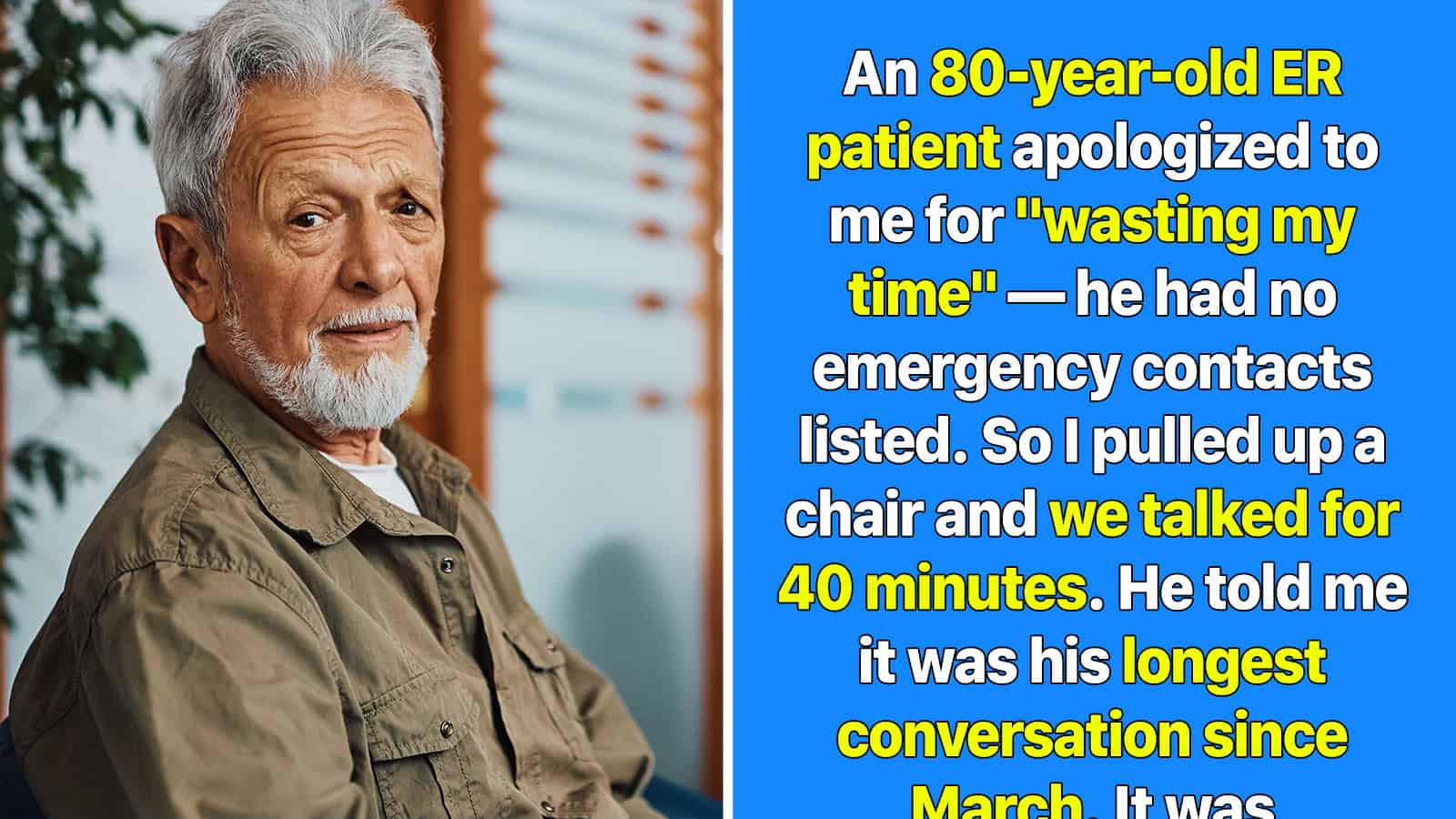
I work night shift in the ER. Twenty-two years. You get hard, or you get out. A man came in around 3 a.m. after a fall—eighty-something, no emergency contacts listed, none. While I was setting his IV he apologized for wasting my time. That’s what he said. “I know you have real patients.”
I finished the line. Then I pulled up a chair, which I never do, and said, “You’re my only patient until this chair gets tired.” We talked forty minutes. Korea. A wife named Ruth. A dog he still sets out water for even though the dog’s been gone two years. Before discharge he gripped my hand and said, “That’s the longest conversation I’ve had since March.” It was November.
I keep the chair by his old bay now. The other nurses use it too. We call it the forty-minute chair. Hardness keeps you standing in this job. But it’s the soft moments that keep you human.
2. “He Told Me Not to Make It Weird”
Okay so I drive a tow truck and I fully expected this job to make me hate humanity, and honestly some days it does, but last February I get called out at 1 a.m. For a dead battery in a grocery store parking lot and it’s a mom with two kids asleep in the back seat and a trunk absolutely FULL of groceries, like clearly the big monthly shop, and she’s crying before I even get out of the truck because she thinks she can’t afford the call. Turns out her card had already declined once inside and a bagger—a teenager, maybe seventeen—had quietly paid the difference out of his own pocket and told her not to make it weird. Her words. “He told me not to make it weird.”
So obviously I jumped the battery for free because what am I, a monster? And she goes, “Why is everyone being so nice tonight?” and I didn’t have an answer then but I do now. Kindness is contagious in the most literal way. That kid infected me. I’ve waived eleven calls since. Not making it weird.
3. Big Step, Mrs. H.
My husband, Gerald, passed in the spring after fifty-four years of marriage, and I will confess that for months afterward I continued shopping for two. Habit is a stubborn houseguest. Each week I would reach the register with his oatmeal, his awful pickled herring, his crossword magazines, and each week a young cashier named Dominic would ring it all through without comment.
One Thursday I finally left the herring on the shelf. When I reached the register, Dominic looked at my little basket, then at me, and said, “Big step, Mrs. H.” That was all. Three words. He had noticed everything, all those months, and had simply been waiting alongside me.
I wept right there next to the chewing gum, and he came around the register and held my hands, and an entire line of strangers waited without one sigh of complaint. Grief, I have learned, is not something you carry alone. It is something the decent people around you quietly agree to carry with you, whether you’ve noticed them doing it or not.
4. The Girl Whose Mom “Packed Two”

Everyone at my school knew Marcus didn’t eat lunch. He’d sit at the end of our table with a water bottle and act like he was “just not hungry,” every single day, and everyone let him have the lie because calling it out felt crueler than ignoring it. I was fifteen and didn’t know what to do with any of that.
Then this girl Priya transferred in. Second week, she sits down, slides half her sandwich across the table to Marcus and goes, “My mom packs two. It’s a whole thing. Please help me.” It was SO obviously not true. Her mom did not pack two. But she said it so casually that Marcus could take the sandwich without taking charity, and that was the entire genius of it.
She did it every day for two years. Different excuses. “Made too much pasta.” “Hate this granola bar, take it.” By senior year half the table had developed mysterious surpluses. Priya taught a whole cafeteria that the highest form of kindness is the kind that protects someone’s dignity while it feeds them. Marcus gave a speech at graduation. Guess who he thanked first.
5. Boxes Are Patient
I got divorced in October and by “divorced” I mean I stood in the driveway of the house we’d built together while a moving crew I couldn’t really afford loaded fourteen years of my life into a truck, and I was doing that thing where you hold your face very still because if one muscle moves the whole thing goes, and the crew chief—a huge man named Sal with a neck tattoo and the gentlest voice I’ve ever heard—stopped in front of me holding our wedding china and asked, “This coming or staying?” and I couldn’t answer, just couldn’t, and instead of getting impatient he set the box down on the lawn, sat on it like a stool, and said, “Take your time. Boxes are patient. So am I.”
We sat on my ex-husband’s lawn for ten minutes, me and this stranger, not talking, until I said “staying” and he nodded like I’d said something wise and carried on.
At the new apartment he refused the tip, pressed his card into my hand, and said, “Second moves are easier. Call me when you buy your own place.” Two years later, I did. He remembered me. He gave me a discount he called the “told you so” rate. Some strangers hold your boxes. The rare ones hold your place in the world until you can come back for it.
6. Eleven Days of Silence, Four Floors Down
My daughter is six and asks approximately four hundred questions a day, so when she asked, “Why does the man in 4B never get visitors?” I gave a lazy dad answer: “Some people like being alone.”
She frowned at me the way only a six-year-old can. “How do you know he likes it?”
I didn’t. Obviously I didn’t. So Saturday morning she made me knock on 4B with her, holding a drawing of what she claimed was his cat but was frankly a potato with ears. The door opened about four inches. Mr. Okafor, seventy-nine, retired postal worker, widower. She held up the potato-cat. “This is for you. Does your cat have a name?”
The door opened the rest of the way.
That was three years ago. He comes to her birthday parties now. She waters his plants when he visits his brother. Last month he told me, “I had gone eleven days without speaking out loud before she knocked.” Eleven days. Four floors below us. My daughter didn’t do anything special. She just refused to assume that someone’s silence meant they wanted it. I’m still learning that lesson from her.
7. Grief Burns Calories

Things I learned in four years as a hospice volunteer:
That nobody, at the end, talks about their promotions. That everyone, at the end, talks about a porch, a kitchen, a lake, a person. That the question “What was she like?” opens doors morphine can’t touch.
One patient, Eleanor, ninety-one, sharp as broken glass, caught me crying in the hallway after another patient passed. She waved me into her room. I thought she’d comfort me. Instead she said, “Good. You still cry. The day this stops hurting, quit—you’ll be no use to any of us.”
Then she made me split her contraband chocolate bar with her, because, she said, grief burns calories.
Eleanor’s been gone five years. I still volunteer. I still cry. She taught me that a soft heart isn’t a weakness you overcome to do hard work. It’s the qualification.
8. The Winter Special That Never Existed
Look, I’m a plumber, not a philosopher, but here’s my story anyway. Got called to a house last winter—burst pipe, water everywhere, absolute disaster. Homeowner is a young guy, maybe twenty-five, and while I’m working I notice the place is basically empty. Folding chair. Air mattress. One pan. He mentions, super casually, that he’d just gotten custody of his little brother after their mom passed, moved here for the school district, and “things were tight until payday.”
The repair was $480. I wrote the invoice for $80 and told him we were running a winter special. There is no winter special. There has never been a winter special. My wife invented one on the spot when I texted her, because she’s faster at lying for good reasons than I am.
Here’s the part that gets me, though. Six months later a review shows up online: five stars, and one line. “This company came when everything in my life was underwater. Not just the kitchen.” I sat in my van and read it about nine times. You think you’re fixing pipes. Sometimes you find out you were holding up a whole house.
9. Brave in Two Languages
When I came to this country I had two suitcases, my grandmother’s recipe book, and English that lived mostly in my notebook, not yet in my mouth. I found work washing dishes in a bakery. The owner, Mrs. Teresa, corrected my English every day. Not soft corrections. Loud ones, across the kitchen. I thought she was cruel. I complained about her in letters home.
Then one morning I came in early and found her at the register, practicing. Practicing words from MY language. From a little book. Terrible accent, worse than my English. She saw me and was embarrassed, and she said, “If you must be brave all day in my language, I can be brave ten minutes in yours.”
Fourteen years I worked for her. When I opened my own bakery she came opening day and inspected everything like a general, and found one thing to say: “The bread is good. The English is good. I take credit for one of them.” She let me decide which. Some people love you loudly and sideways. It took me years to hear it. I hear it now.
10. A Year of Hellos
There’s a woman who rides my bus route every Friday evening. For a year she got off at the hospital stop, and every Friday she looked a little smaller, the way people do when they’re visiting someone who isn’t getting better. We never spoke beyond hello. I’m a bus driver. Hello is most of my vocabulary on the clock.
Then one Friday in June she got on and rode past the hospital stop. Didn’t ring the bell. Just sat there with her hands folded, staring at nothing, and I understood. I drove my route. When she was finally the last passenger, end of the line, 9:40 p.m., I turned off the interior lights the way you do at close, but I didn’t rush her. I said, “Take whatever time you need. This bus isn’t going anywhere.”
She sat for maybe six minutes. Then she came up front, touched the fare box like it was a shoulder, and said, “Thank you for a year of hellos. Some weeks that was the only thing that felt normal.”
I think about that constantly. A hello. That was it. That was the whole intervention. You never know when your smallest routine kindness is somebody else’s last piece of solid ground. So keep offering it. Every single stop.
Compassion rarely announces itself. It shows up in folding chairs, half sandwiches, waived invoices, and one more hello than anyone was owed. If one of these stories reminded you of someone, tell them—today counts, and so do you.